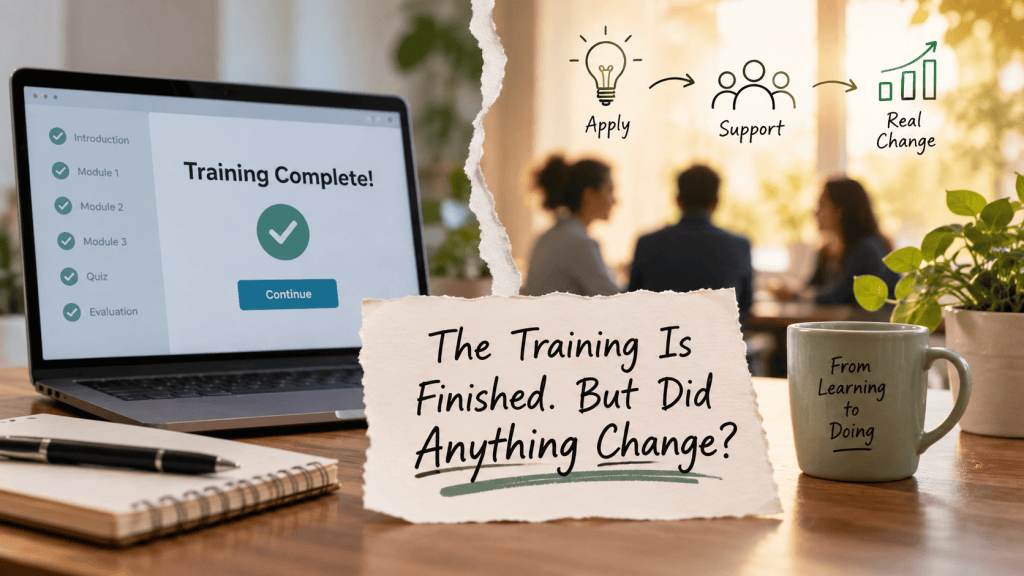
I have to admit, when I first started learning about design thinking, I thought a lot about how to create better training.
How do we make it more interesting? How do we keep people engaged? How do we make sure the information makes sense?
Those are all important questions.
But as we’ve been moving through this course, I’m realizing there is another question that might be even more important.
What happens after the training is over?
Someone can finish a course, pass a quiz, and walk away with a certificate. But does that mean anything actually changed?
Can they use what they learned? Do they feel more confident? Did the training help with the problem we were trying to solve in the first place?
I think that’s what stood out to me most about this week’s readings. Designing something is one thing. Making sure it actually helps people is something else.
And maybe that’s where the real work begins.
Finishing the Training Isn’t the Same as Learning
Boller and Fletcher (2020) spend time discussing what happens when a training solution is actually put into practice and how we evaluate whether it worked.
That made me think about how easy it is to measure the things we can see.
How many people completed the training? Did they pass the quiz? Did they fill out the evaluation?
Those things can tell us something, but they don’t necessarily tell us whether anyone is doing anything differently.
I keep thinking about the example of training new supervisors to have difficult conversations with employees.
We could create a course with good information, realistic examples, and a quiz at the end. Everyone might complete it and even give it positive feedback.
But what happens when a supervisor has to sit across from an employee and actually have that uncomfortable conversation?
Do they feel prepared? Can they apply what they learned? Do they have someone they can go to when they’re unsure what to do?
Those are the questions I would want to ask.
One thing I’m taking from Boller and Fletcher is that we can’t treat implementation and evaluation like boxes to check after we’ve finished designing. We need to think about what success will look like in the real world and how we’ll know whether we’re getting there.
A completed training isn’t necessarily a successful training.
And I think that’s an important difference.
Meeting People Where They Are Still Matters
Something I keep coming back to throughout this course is the idea of meeting people where they are.
Working in harm reduction, that’s a phrase that means a lot to me. We can’t assume everyone is starting from the same place, has the same experiences, or needs the same kind of support.
And the more I learn about instructional design, the more I see that the same idea applies to training.
Boller and Fletcher (2020) discuss the importance of getting buy-in from stakeholders and continuing to use design thinking even after a project is already underway. That stood out to me because it reminds me that we can’t just design something, hand it over, and assume everyone will be ready to use it.
People have different levels of experience, different concerns, and different things getting in their way.
I also thought about the CAISO case study, where the designers used a learner persona to keep the needs of a newer employee in mind throughout the project (Boller & Fletcher, 2020). I liked that the persona wasn’t just something they created at the beginning and forgot about. It helped guide their decisions.
That made me wonder how often we really keep the learner in mind once we get busy building the training.
Are we still thinking about what that person needs? Or are we more focused on finishing the project?
I think that’s a question worth asking, especially when we’re trying to create something people can actually use.
What If Making Mistakes Is Part of Learning?
Amy Edmondson’s (2011) reading about learning from failure really made me stop and think.
I think most of us grow up seeing mistakes as something we’re supposed to avoid. We want to get things right, and we definitely don’t want other people noticing when we get something wrong.
But Edmondson explains that not all failures are the same. Some are preventable, some happen because situations are complicated, and some are part of trying something new.
That distinction matters.
If we’re expecting people to learn a new skill, shouldn’t we also expect that they might struggle with it at first?
I thought again about those new supervisors learning how to have difficult conversations. They can practice what to say during training, but their first real conversation probably won’t go exactly as planned.
And that’s okay. What matters is whether they have a chance to reflect, ask questions, and get better.
Edmondson (2011) also talks about creating an environment where people feel safe enough to acknowledge mistakes instead of hiding them.
That made me think about the kind of support we provide after training. If someone tries a new skill and it doesn’t go well, do we help them figure out what happened? Or do we make them feel like they should have known better?
I don’t think learning stops when someone makes a mistake.
Sometimes, that might be when the most important learning happens.
What If We’re Solving the Wrong Problem?
One story from Tom and David Kelley’s (2012) reading really stuck with me.
A design team was working on creating a less expensive incubator for premature babies. That sounds like a good idea, right?
But when they actually visited families in rural Nepal, they discovered something important. The problem wasn’t just that hospitals needed cheaper incubators. Many families lived too far from a hospital to use one in the first place.
So the team started thinking differently about what those families actually needed.
I loved that example because it shows how easy it is to start working on a solution before we fully understand the problem.
And I have to admit, I can see how that happens with training, too.
Someone says employees need more training, and we start planning a workshop or an online course. But what if the real issue is that they don’t have enough time, support, or resources to do the job?
More training might not fix any of that.
Kelley and Kelley (2012) also talk about building creative confidence by being willing to try things, take small steps, and get comfortable with uncertainty.
I think that’s something I’m still learning. It’s okay not to have the answer right away. Sometimes asking another question or listening a little longer is what helps us find a better direction.
Maybe being a good designer isn’t about having all the answers.
Maybe it’s about being willing to question the first answer we come up with.
It’s Not Just About Making Something Look Better
Writing
I also thought about the interview with Indra Nooyi and how she brought design thinking into PepsiCo’s strategy (Ignatius, 2015).
What stood out to me was that she wasn’t just talking about making products or packaging look nicer. She wanted people to think about the whole experience someone has with a product.
That made me think about training in a different way.
We can spend so much time making sure a presentation looks good, the activities are interesting, and everything is organized. And those things do matter.
But what about the experience someone has when they go back to work and try to use what they learned?
Do they have the tools they need? Does their supervisor support them? Is the process they’re being asked to follow even realistic?
I think that’s where design thinking can make a difference. It pushes us to look beyond what we’re creating and think about what people are actually experiencing.
And honestly, that connects right back to the question I started this blog with.
Did anything really change?
Because if the training looks great but people are still struggling with the same problems, I think we have to be willing to go back, ask more questions, and try something different.
So, What Am I Taking Away From This?
The more I learn about design thinking, the more I realize it’s not just about coming up with creative ideas or building better training.
It’s about paying attention to what happens when people actually try to use what we’ve created.
This week’s readings reminded me that we have to be willing to listen, make adjustments, learn from mistakes, and sometimes admit that our first idea wasn’t the right one.
I keep coming back to that idea of meeting people where they are. For me, that means understanding what people are dealing with before deciding what kind of help they need. And it means continuing to pay attention even after we’ve offered that help.
I’m starting to see that designing training isn’t really finished just because the training itself is finished.
Maybe the better question isn’t just whether people learned something.
It’s whether what they learned made a difference.
And that’s something I want to keep asking as I continue through this course.
References
Boller, S., & Fletcher, L. (2020). Design thinking for training and development: Creating learning journeys that get results. Association for Talent Development.
Edmondson, A. C. (2011). Strategies for learning from failure. Harvard Business Review.
Ignatius, A. (2015). How Indra Nooyi turned design thinking into strategy. Harvard Business Review.
Kelley, T., & Kelley, D. (2012). Reclaim your creative confidence. Harvard Business Review.

