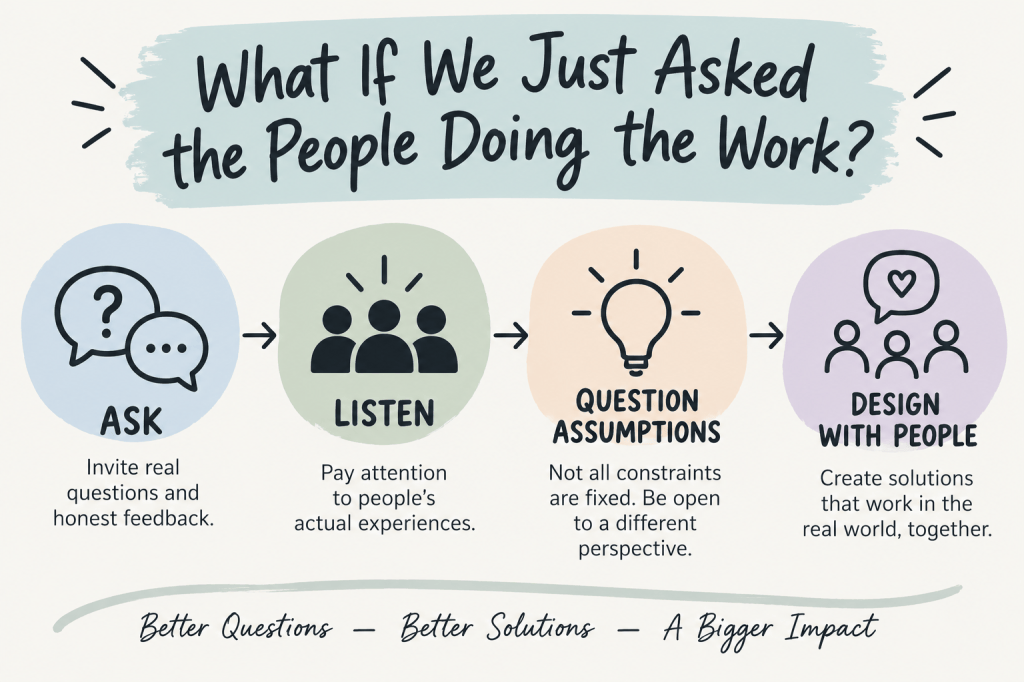
When I finished this week’s readings, I kept coming back to one thought: Why do we sometimes make decisions for people without asking the people who actually have to do the work?
It seems like an obvious question, but I am starting to realize that a lot of the ideas in design thinking sound obvious until I think about how often we actually do the opposite.
Last week, I wrote about making sure we are solving the right problem before becoming too attached to a solution. This week’s readings made me think about what comes next. Even if I believe I understand the problem, how do I know that my understanding is accurate if I have not talked to the people who experience it every day?
Boller and Fletcher explain that getting the learner’s perspective means understanding much more than basic information about who the learner is. It includes understanding their daily environment, the tools they use, the tasks they perform, the challenges they face, and even what they are thinking and feeling while doing the work (Boller & Fletcher, 2020).
That made me think about something that seems pretty simple:
The person closest to the problem may know something that the person designing the solution does not.
And if we never ask them, we may never find out.
There Is a Difference Between Knowing About Someone and Listening to Them
Boller and Fletcher’s discussion of learner perspective was probably the part of this week’s reading that connected most with me. They explain that a traditional needs analysis may look at what someone is currently doing, what they should be doing, and the gap between the two. Getting the learner’s perspective goes deeper because it looks at the person’s actual experience while doing the work (Boller & Fletcher, 2020).
I can see how easy it would be to skip this step. If I already know someone’s job, I might assume that I understand what they need. I could look at their job description, their required tasks, or the training they have completed and feel like I have enough information.
But none of those things necessarily tell me what it is actually like to do that job every day.
One example in the reading involved observing an employee who was talking about her onboarding experience. She explained that the required courses looked so much alike that by the time she finished one, she could not even remember which course she had just completed (Boller & Fletcher, 2020).
I immediately thought back to the mandatory SOP training I wrote about last week. From the outside, someone can see that I was assigned the training, completed it, and met the requirement. What they cannot see from a completion record is the point when I have been reading for so long that the words start running together.
That information would only come from actually asking me about my experience.
Maybe data can tell us what happened, but people can sometimes tell us why it happened.
Being Efficient Does Not Always Mean It Is Working
Bason and Austin gave an example that really stood out to me. A government agency in Denmark had employees who believed they were doing their jobs well. Their case-management processes were efficient, and they had even received productivity awards. However, when the organization actually listened to the people using its services, it discovered something very different. The process worked well for the agency, but it was not working nearly as well for the clients they were supposed to be helping (Bason & Austin, 2020).
I think this is a good example of how easy it is to measure the wrong thing. If the only thing being measured is how quickly something gets completed or how many people finish a process, the numbers might look great. That does not necessarily mean the experience itself is good.
This also made me think about the workplace. There are plenty of processes that make sense from an organizational standpoint because they are easier to track, document, or manage. But the employee who actually has to follow the process may see problems that are invisible to the person who created it.
What I found interesting is that hearing those problems can also be uncomfortable. Bason and Austin explain that design thinking can force people to question practices they believed were already working. Leaders have to create an environment where people can hear that feedback without immediately becoming defensive (Bason & Austin, 2020).
Listening only works if we are willing to hear an answer we did not expect.
Sometimes a Constraint Is Really an Assumption
Another idea that made me stop and think was the difference between a real constraint and an assumed one. Boller and Fletcher identify five major types of constraints: budget, time, technology, people, and environment. What interested me more, though, was their point that something we call a constraint may not actually be as fixed as we think it is (Boller & Fletcher, 2020).
I think this happens a lot in the workplace. We hear things like, “We don’t have time for that,” “That’s the way we have always done it,” or “We can’t change the system.” Sometimes those things are absolutely true. There are deadlines, budgets, policies, and technology limitations that cannot just be ignored. But sometimes I think we accept an answer as a fact because no one has stopped to ask whether it is still true.
This connects back to listening to the people doing the work. They may know where a process slows down, where unnecessary steps exist, or where a tool creates more work instead of less. Someone looking at the process from a distance may only see the rules and limitations. The person actually working inside the process sees what those limitations look like in practice.
To me, this does not mean ignoring constraints. It means questioning them enough to know which ones we actually have to work around and which ones we may be able to change.
“We can’t” and “we haven’t tried” are not always the same thing.
A Good Solution Still Has to Work in the Real World
Brown and Martin added another part to this that I had not really considered before. Finding a good solution is not necessarily the end of the design process. People still have to accept it, use it, and make it part of what they actually do. The authors argue that when a new idea requires people to change established behaviors, the way the solution is introduced becomes part of the design itself (Brown & Martin, 2020).
Their example of Innova Schools helped make this idea more concrete for me. Instead of creating a new school model behind closed doors and then expecting everyone to adjust to it, the designers involved students, teachers, parents, and other stakeholders. They tested ideas, gathered feedback, and continued making changes as the model moved into actual classrooms (Brown & Martin, 2020).
I think this matters because it is easy to assume that if an idea is good enough, people will automatically use it. In reality, people may resist a change because they do not understand it, were never included in it, or because the solution does not work as well in their daily lives as it did on paper.
This brings me back to the question I started with. Asking people about their experience should not be something we do once at the beginning and then forget about. Their perspective matters while we are defining the problem, while we are designing the solution, and while we are figuring out whether that solution actually works.
Designing for people should probably include designing with them.
What I Am Taking Away From This
The biggest thing I am taking away from these readings is that listening cannot just be something we say we value. We actually have to make room for it in the process. That means asking people questions, paying attention to their experiences, and being willing to change our assumptions when what they tell us does not match what we expected.
I also think there is a difference between asking for someone’s opinion and actually being willing to do something with it. If people are repeatedly asked for feedback but nothing ever changes, eventually I would imagine they stop believing that their input matters.
For me, this week’s readings added another layer to what I learned last week. Last week I was thinking about whether we are solving the right problem. Now I am thinking that maybe one of the best ways to answer that question is to stop assuming we already know what people need and actually include them in figuring it out.
Sometimes the people we are trying to help do not need us to have all the answers. They need us to ask better questions and actually listen to the answers.
References
Boller, S., & Fletcher, L. (2020). Design thinking for training and development: Creating learning journeys that get results. ATD Press.
Bason, C., & Austin, R. D. (2020). The right way to lead design thinking. In HBR’s 10 must reads on design thinking. Harvard Business Review Press.
Brown, T., & Martin, R. L. (2020). Design for action. In HBR’s 10 must reads on design thinking. Harvard Business Review Press.

