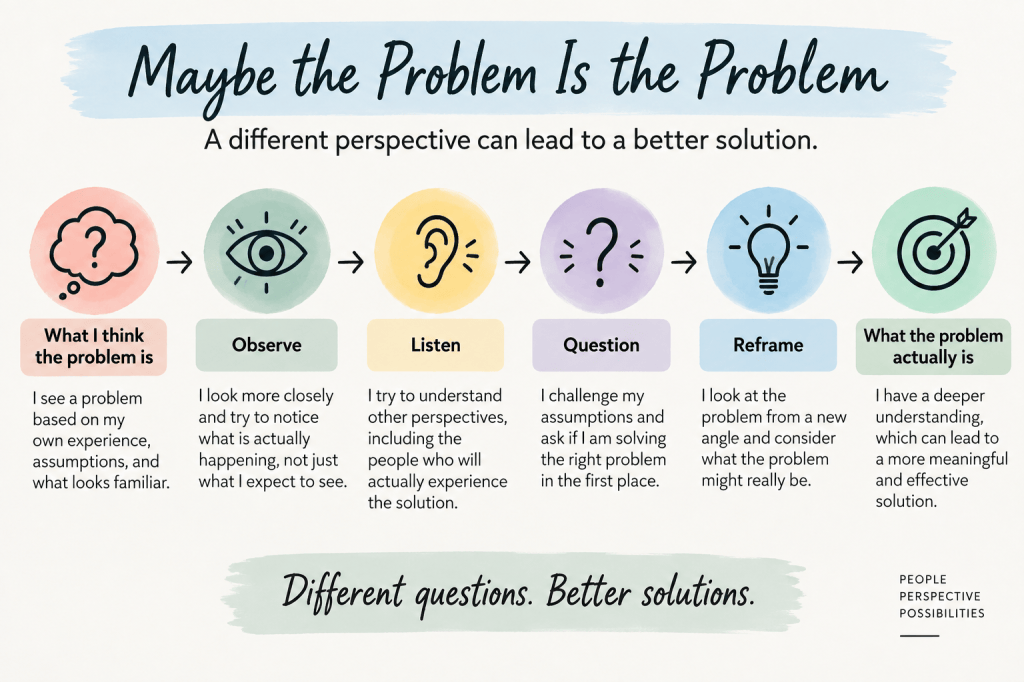
When I first saw that we were going to be learning about design thinking, I thought it was going to be mostly about coming up with creative ideas and finding better solutions to problems. After doing this week’s readings, I realized that I was looking at it a little backwards. What stood out to me the most is that design thinking is not just about finding a solution. It is also about taking the time to figure out if we really understand the problem in the first place.
That sounds simple, but the more I thought about it, the more I realized how often we probably skip that part.
When we see a problem that looks familiar, our first instinct is usually to start thinking about how to fix it. We use what we already know and what has worked before. I have always thought of experience as an advantage, and I still do, but these readings made me think about the other side of experience. Can knowing a lot about something actually make it harder to see it differently?
Seeing the Problem Through Someone Else’s Eyes
Tim Brown’s discussion of human-centered design was one of the first things that made me think differently. Brown explains that design thinking starts with understanding people’s actual needs and then considering what is possible from a technology and business standpoint (Brown, 2020).
Brown also identifies empathy as an important characteristic of a design thinker. He describes empathy as being able to look at the world from different perspectives, including those of customers, coworkers, and the people who will actually use what is being designed (Brown, 2020).
At first, empathy seemed like the most obvious part of design thinking to me. Of course we should think about the people we are designing something for. But I started realizing that there is a difference between thinking about someone and actually trying to understand an experience from that person’s point of view.
The example from Jeanne Liedtka’s reading really brought this home for me.
She describes a designer working with Pete, a nonverbal adult with autism. Pete would do things such as pick at a leather sofa and rub indentations in a wall. At first, those actions were viewed as destructive behavior. But the designer eventually tried mirroring some of his actions herself. She began to understand that what looked destructive from her perspective could actually be a satisfying sensory experience for Pete. That completely changed how she thought about the problem (Liedtka, 2020).
This example probably stayed with me more than anything else I read this week.
Pete’s behavior did not change. The person observing him changed her understanding of it.
That is when design thinking started making more sense to me. If we misunderstand someone’s experience, we can probably create a very good solution to the completely wrong problem.
Are We Training People or Helping Them Learn?
Boller and Fletcher’s discussion about learning being a journey instead of a one-time event really connected with me because of the training I do at work. I regularly complete mandatory training that involves reading SOPs (standard operating procedures), and some of them are extremely lengthy. From the company’s perspective, the training has been completed once I read the material and check the required box. Technically, I have completed the training, but that does not always mean I have actually learned the information.
I have had times when an SOP is so long that, after a while, all the words start running together. I am still reading, but I am not necessarily absorbing what I am reading. I may finish it and be able to say that I completed the requirement, but if someone asked me later to explain everything that was covered, I probably could not do it. This week’s reading made me realize that completing training and actually learning from training are two different things (Boller & Fletcher, 2020).
This also made me look at mandatory training a little differently. If the goal is only to document that I read an SOP, then checking the box accomplishes that goal. But if the goal is for me to understand, remember, and use the information, checking the box may not be enough.
I am not saying that lengthy SOPs are unnecessary. Depending on the workplace, all of that information may be important. What I am questioning now is whether presenting all of the information at once is the same thing as creating an effective learning experience. Maybe the better question is not How do we make sure employees complete the training? but How do we design the training so employees can actually use what they learned when they need it?
That distinction between completion and learning is something I probably would not have thought much about before this week’s readings.
Being Comfortable With Something That Is Not Finished
Another idea that caught my attention this week was prototyping. This part goes against how I normally think about presenting my work. Usually, I do not want someone to see something until I think it is finished. Showing unfinished work can make it feel like I did not put enough effort into it.
Design thinking looks at unfinished work differently.
Brown explains that the purpose of a prototype is not to create a finished product. Instead, it gives designers an opportunity to learn what works, what does not work, and what may need to change. He also points out that when too much time and effort are put into a prototype, people may become more attached to it and less willing to listen to feedback (Brown, 2020).
Liedtka makes a similar point. Rough and inexpensive prototypes allow people to experience an idea before a large amount of time or money has been invested in it. Because the idea is still unfinished, there is more room to change it based on what is learned from others (Liedtka, 2020).
I had never really thought about unfinished work as having an advantage. Normally, I think of feedback as something that comes toward the end, after I have tried to make something as good as I can. Design thinking seems to turn that around. Feedback needs to happen early enough that it can actually change what I am doing.
I can see why that could be uncomfortable. It means being willing to hear that an idea I like might not work. It also means being willing to change direction instead of defending something just because I have already spent time on it. Maybe unfinished does not always mean unprepared. Sometimes it means there is still room to learn.
What I Am Taking Away From Week 1
After these readings, I do not think design thinking is simply about being creative. I think it has just as much to do with being curious and being willing to admit that our first understanding of a problem may be wrong.
Brown describes design thinking as moving through inspiration, ideation, and implementation, but these are not steps that always move neatly in one direction. A designer may have to go backward when new information changes the problem or the idea (Brown, 2020). Liedtka also points out that when we define problems in ordinary and predictable ways, we tend to come up with ordinary and predictable solutions. Sometimes getting a better answer starts with asking a better question (Liedtka, 2020).
I think that is probably my biggest takeaway from this first week. I have always associated being knowledgeable with having answers. These readings made me think that sometimes being knowledgeable may also mean knowing when to stop and ask more questions.
As I continue through this course, one question I want to keep thinking about is:
How do we know when we have spent enough time understanding a problem and it is finally time to start solving it?
There probably is not one perfect answer to that question. But maybe that is part of design thinking too.
For now, I am starting Week 1 with one idea that I did not have before:
Before I become too attached to my solution, I need to make sure I am solving the right problem.
References
Boller, S., & Fletcher, L. (2020). Design thinking for training and development: Creating learning journeys that get results. ATD Press.
Brown, T. (2020). Design thinking. In HBR’s 10 must reads on design thinking. Harvard Business Review Press. (Original work published 2008).
Liedtka, J. M. (2020). Why design thinking works. In HBR’s 10 must reads on design thinking. Harvard Business Review Press. (Original work published 2018).

